What does AI mean in safeguarding?
Watch the explainer first, then read on for the worked example. ~10-minute total · video plus reading.
When people say AI is being used in safeguarding, they could mean three very different things. They might mean a system that calculates a risk score for a child before anyone has knocked on the door. They might mean a tool that reads thousands of case files and flags recurring patterns. Or they might mean a practitioner using ChatGPT or Copilot to help write up a child and family assessment after a visit.
These are not the same thing. They carry different risks, raise different ethical questions, and require different responses from you. Module 6 taught you what AI bias looks like across the nine protected characteristics. This module takes that frame straight into safeguarding, where the cost of getting it wrong is highest.
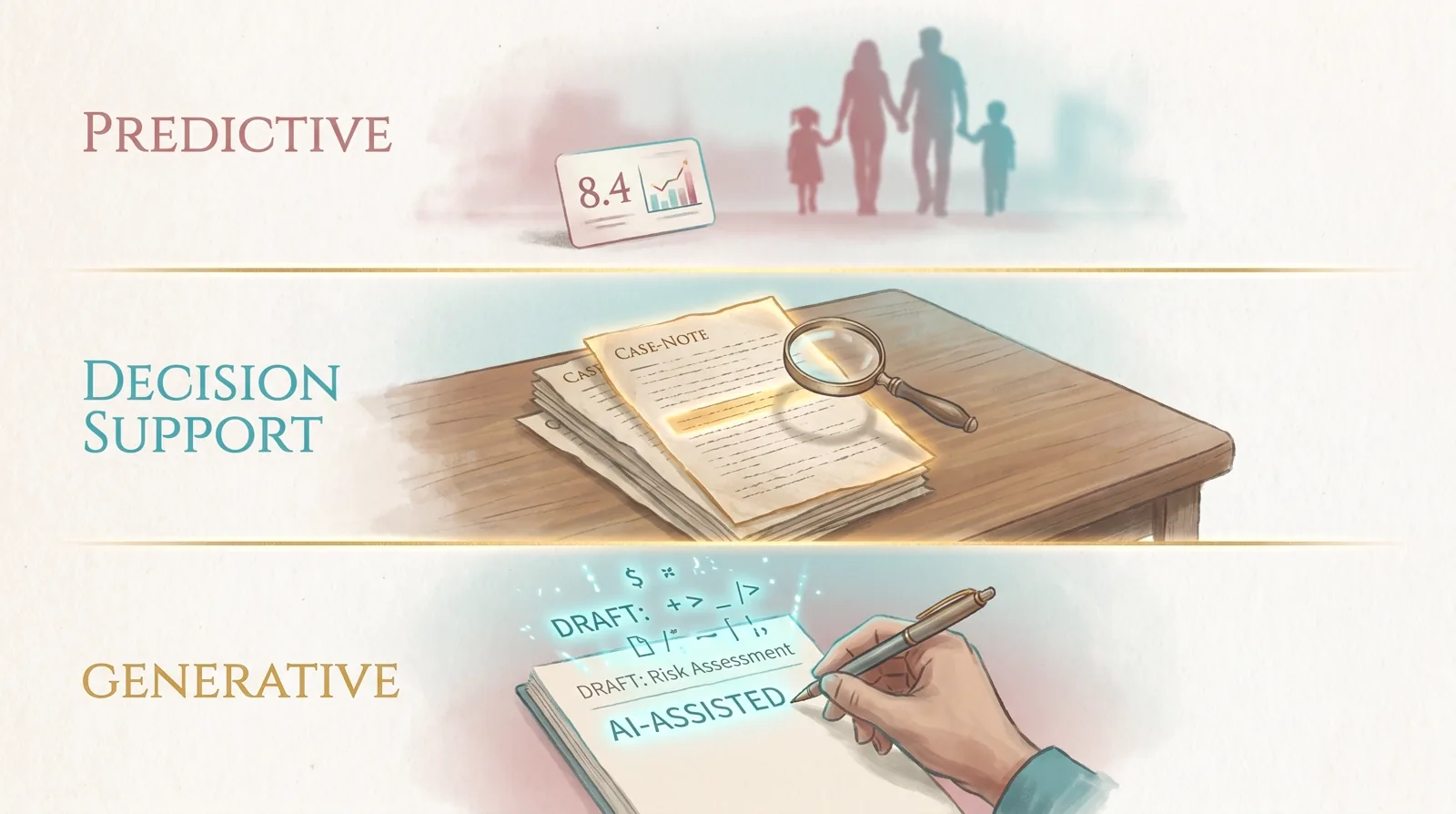
Three types of AI in safeguarding
1. Predictive risk tools (the most controversial)
Tools designed to calculate the likelihood a child will be harmed before harm has occurred. Used most extensively in the United States and parts of northern Europe.
Children's services are stretched and caseloads are large. If an algorithm can identify which families most need attention, the argument goes, resources can be directed where they will do the most good.
The track record is mixed at best. Some tools have been withdrawn after concerns surfaced; others remain operational but contested. The detail matters.
Rapid Safety Feedback (RSF)
The state's DCFS Director called it unreliable. It gave 369 children a "100% probability" of death or serious injury, while missing high-profile child deaths it should have caught, including 17-month-old Semaj Crosby.
Source: Illinois DCFS / contemporaneous reporting
Decision Support System
Audited in 2024 by Hansen, Sinatra and Sekara at ACM FAccT. They found inappropriate proxies for maltreatment, age-based discrimination, and risk scores that varied wildly depending on the child's age. Several Danish pilots have since been paused or cancelled.
Source: Hansen, Sinatra and Sekara (2024), Failing Our Youngest, ACM FAccT
Allegheny Family Screening Tool
Still in use as a call-screening decision support, but the subject of a US Department of Justice investigation opened in 2023. The DoJ is examining whether the tool violates the Americans with Disabilities Act by flagging parents with disabilities as a risk factor.
Source: 2022 Associated Press investigation; DoJ 2023 Letter of Interest
The Department for Education's Guidance for developing data analytics tools in children's social care (18 April 2024) is explicit. Predictive tools should only be used by councils with "high data maturity" and "advanced technical expertise", and the guidance classifies any tool that predicts individual family outcomes as higher risk, requiring a Capability Assessment Stage before deployment.
These tools are not widely deployed in English children's social care at the time of writing. But they are being discussed.
2. Decision support and pattern-recognition tools
Tools that work with information you already have, rather than predicting from scratch. They surface what's already in the file.
- Read large sets of case notes and surface recurring themes across multiple workers and years
- Flag patterns you might miss: a child with three referrals in 18 months, same concern, no s47 enquiry opened
- Connect dots across documents that no single human could read in a working day
The tool raises questions rather than answers them. It says "have you seen this?" not "do this."
"It pulled together six months of case notes from three different workers in about thirty seconds. Every referral came in after a school term started, never in the holidays. That changed the whole shape of the conversation I had with the family."Duty practitioner, on using a chronology tool before a home visit
That is AI working as it should: amplifying what you already know how to do, not replacing your judgement.
3. Generative AI for documentation
The type most practitioners are already using or considering, for case notes, assessment drafts, referral letters, chronologies, court reports.
This is where guidance is thinnest and practice is most varied. Two ways the same tool gets used:
Treats AI output as a first draft. Reviews thoroughly. Verifies facts. Restores the child's voice. Signs only when satisfied.
Files AI-generated content with little checking because the document looks professional and complete. Fluent prose hides what's missing.
Serious case reviews keep finding the same pattern: the child's voice is missing at the point when harm escalates. Generative AI, used without structured prompting, makes that worse. It produces text that sounds authoritative and fills the space where the child's words should be.
This is why VERA:H matters in safeguarding. It is the mechanism that keeps the child in the document.
The data richness problem (and why it is an AOP problem)
You learned in Module 6 that AI absorbs the patterns in the records it was trained on. In child welfare, those records come overwhelmingly from families who have had contact with public services. A family with private therapists, private school, private healthcare leaves almost no trace in the data the system learns from.

- The data gap. Lower-income families have more contact with public services and so leave more trace, while wealthier families do not. The children in those wealthier families are not less safe; they are invisible to the algorithm.
- The amplification. Race and poverty bias predates AI. What AI adds is scale, speed, and the appearance of objectivity, applied to bias that was already in the records it learned from.
- Automation bias. Research on US child welfare workers found practitioners adjusted their own assessments toward an algorithmic risk score, even when their professional judgement pointed somewhere else. That's the central risk you carry into every AI-assisted safeguarding decision.
Mia: how the same case is recorded two different ways
A practitioner visits a nine-year-old called Mia. Mia tells the practitioner what is happening at home.
"I don't like it when mum's friend stays over. He shouts and I have to stay in my room."
She said this looking at the floor, voice barely above a murmur, no eye contact when she mentioned the shouting.
The practitioner writes a case note using AI assistance, with no structured prompt. Then the practitioner re-runs the same task using a VERA:H-anchored prompt with Mia's actual words at the top. Two very different paragraphs.
"The child reported some discomfort regarding the presence of a family associate in the home environment."
Mia (9) said: "I don't like it when mum's friend stays over. He shouts and I have to stay in my room." She said this looking at the floor, voice barely above a murmur, no eye contact when she mentioned the shouting. Practitioner observed visible discomfort consistent with what Mia described.
The first sentence is technically accurate, but it is an incomplete picture. Mia has been removed from her own record. Her words, "I don't like it", "he shouts", "I have to stay in my room", are gone, and the specificity that a subsequent worker, a team manager, or a court would need to assess risk has been smoothed out by the same process that makes the text sound professional.
With the VERA:H-anchored prompt, AI can still help structure the assessment, organise observations under the relevant framework, produce a draft that is well-structured. But the child is present. The practitioner has not outsourced the most important thing to the machine.
Working Together to Safeguard Children (2026) does not name AI directly, but its core principle holds: the welfare of the child is paramount and practitioners must gather and analyse information directly. Children Act 1989, s47: the duty to make enquiries where a child may be at risk of significant harm cannot be delegated to an algorithm. UK GDPR and the Data Protection Act 2018: any AI use that processes personal data about a child or family must comply with data protection law, including how commercial AI tools store or process prompts. Check your organisation's policy before entering identifying information into any AI tool. Article 12, UN Convention on the Rights of the Child: the child's right to be heard does not pause when AI is involved. Ofsted: an assessment that is fluent but voiceless will not meet inspection standards regardless of how well-structured the document is.
What this means for your practice
You are probably already using AI, or working alongside colleagues who are. This module is not telling you to stop. Used well, AI reduces admin, manages volume, and surfaces information that would take hours to find by hand.
What it asks you to do is use it with your eyes open. Three things to hold in mind on every AI-assisted safeguarding task:
- Know what type of AI you're using. Predictive, decision-support, and generative tools carry different risks and need different scrutiny.
- The data reflects historical inequality. AI will reproduce that at scale unless you stop it.
- Fluent ≠ accurate. A document that sounds professional but does not contain the child's voice has failed in the most important thing.
Your job is to make sure that fact is visible in every document you produce.
Pick a recent assessment you wrote or co-signed for a child. Read it back. Whose words appear in the document: yours, the parents', the child's, the AI's? If you removed everything that was not the child's own words or your direct observation of the child, what would be left?