Where the human decision sits
9-minute read. Inflated risk, automation drift, iteration as formulation, and the chain that makes a statutory decision.
Module 6 taught you what AI does to language: it inflates, it smooths, it drifts toward the average it was trained on. Now apply that to safeguarding, where the inflation lives next to a statutory threshold and someone has to decide whether to cross it.
Two thresholds, one principle.
Children Act 1989 · s47
Significant harm triggers a child protection enquiry.
Care Act 2014 · s42
Abuse, neglect, or unable to protect triggers an adult safeguarding enquiry.
Different statutes, same shape, and the threshold call belongs in both cases to the practitioner and the people above them in the chain. The decision is not something AI is positioned to make.
How AI inflates risk
Module 6 showed you the mechanism. Here it is again, with the safeguarding stakes attached.
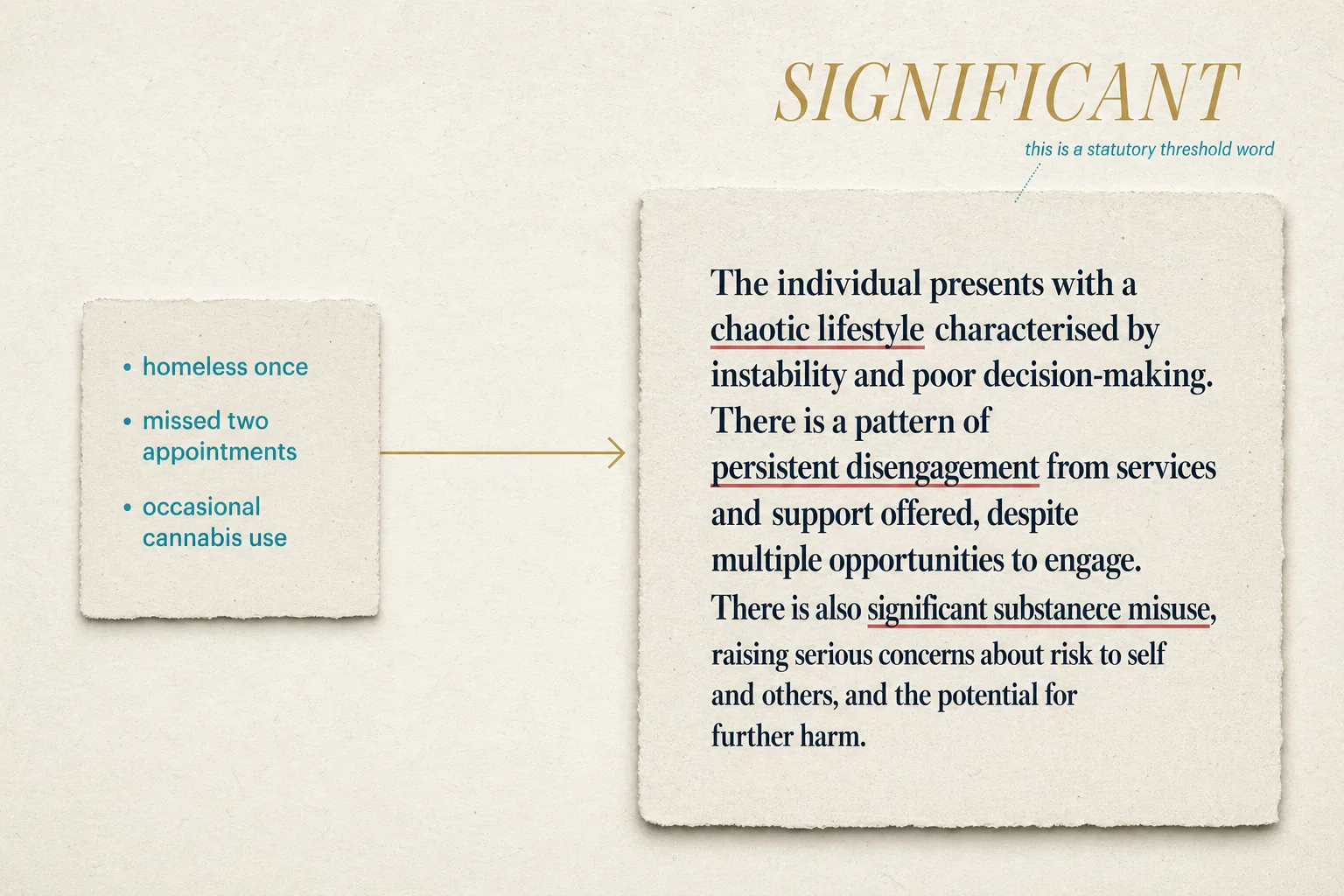
In an AOP module these matter because of bias. In safeguarding they matter because the inflated language sits next to a threshold word. Words like significant and unable to protect are doing legal work in s47 and s42, not adjective work, and AI uses them as adjectives anyway. The threshold word lands in the document with no awareness of what it has just triggered.
A short worked example. A practitioner uploads a four-line referral and AI returns a "professional summary" that uses significant harm in the second sentence. The threshold language is now in the document, attributed implicitly to a human reader, and authored by AI. By the time the document reaches the panel, nobody has flagged who wrote the phrase or whether it was warranted.
Agreeing with the machine when we don't actually agree
In Section 1 we named this as automation bias. It deserves its own pillar because in safeguarding it is the most insidious failure mode.
It does not feel like deferring. It feels like reading and nodding. The AI's paragraph sits in front of you, fluent, structured, confident. Your gut says "I'm not sure this is right", but your gut is quieter than the document, and three referrals later the document is still there while the gut has faded.
This is where the practitioner-supervisor-manager chain becomes load-bearing. You are not the only safeguard. Saying "the AI summary was wrong, so I made changes" out loud, in supervision, is the system functioning as it should. That sentence in a supervision room is the bit that catches the drift the document hides.
Iteration as formulation aid (the good use)
The opposite of agreeing with the machine is arguing with it. Use AI iteratively to think a case through, not to be told what the answer is.
Three prompts worth keeping on a sticky note next to your screen:
These are formulation prompts. They produce questions for you, rather than answers for the file. The output is your sharper thinking, not the record itself. What you put in the document is still yours.
The decision chain (and where AI is not in it)
A safeguarding decision is never the practitioner's alone. Every local authority is different, but your chain might look something like this:
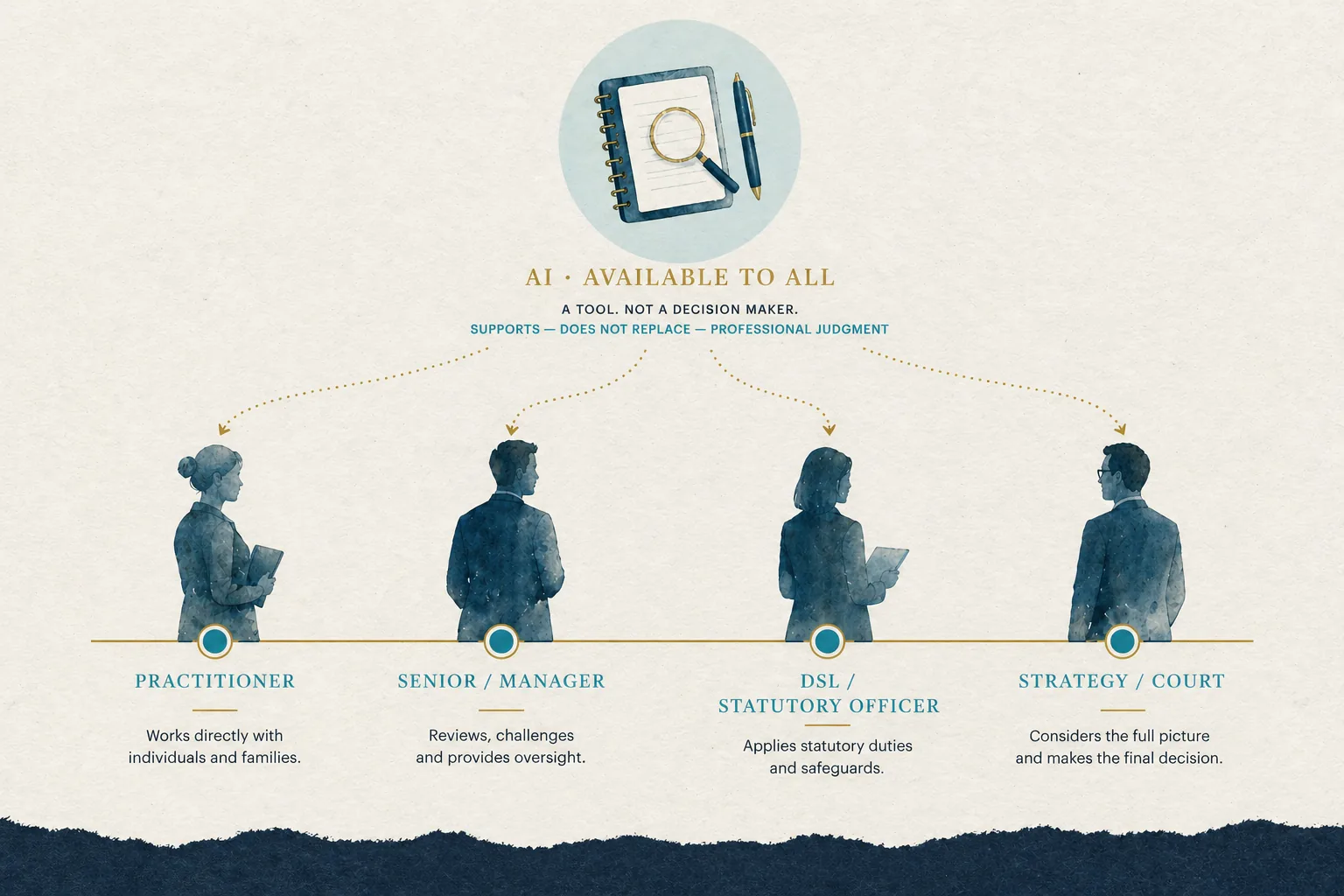
AI is not part of this chain. It is a tool that any practitioner may reach for, but it has no seat at strategy, no signature on a court report, and no role in the moments where someone has to take responsibility for a decision. The chain is human throughout, and that is by design.
- Surface what's in the file
- Flag patterns and gaps
- Group findings by theme
- Prompt your thinking
- Iterate with you on formulation
- Draft for review
- Apply the threshold
- Make the decision
- Sign anything
- Take the consequences
- Sit in the room with the family
- Be accountable to the panel
- Use AI for everything in the first column
- Bring the surfaced material to your supervisor
- Defend the decision in your own voice
- Trust the chain above and around you
The threshold is statutory and the chain is human all the way through.
Pick one safeguarding decision you have been involved in over the past quarter. If AI had been in the loop, where in the chain would it have been useful? Where in the chain would it have been dangerous? Who in the chain would you trust to catch an AI-introduced inflation that you missed?