Children's and adults' tracks. Built on the AOP foundation from Module 6.
4/7
Section progress
~10 minutes · interactive
Pulling data out: friction-first prompting
10 minutes including the interactive. How to prompt AI so contradictions, gaps and concerns surface, instead of being smoothed into a tidy paragraph.
In safeguarding, the work lives in the cracks: the contradictions across notes, the concern raised once and not followed up, the disagreement at the strategy meeting that got smoothed in the minutes, the child's voice that was there in 2021 and gone by 2023.
When AI extracts information for you, its default is to fill those cracks in with polished paragraphs and a neutral register, returning sentences like "The case has been broadly consistent." That sentence is the opposite of safeguarding. Serious case reviews keep finding the same shape: the harm escalated in the cracks, and the cracks were the bit that wasn't recorded clearly enough to act on.
Try it: spot the smoothing
Below is a polished AI summary of a case. It sounds professional and complete. Find the five places where AI has smoothed something dangerous away.
Tap any phrase that looks suspicious. If you find one of the five smoothing patterns, the explanation will reveal below.
0 of 5 smoothing patterns found
Across the seven-year history of this case, the family's situation has been
broadly consistent across the records.
The child's wishes were considered throughout
by the practitioners involved. Where
concerns were noted and reviewed
through the appropriate channels, the response was timely. The
professionals were aligned in their assessment
of the family's strengths and challenges. Taken as a whole, the case presents
a significant safeguarding risk
that warrants continued multi-agency oversight.
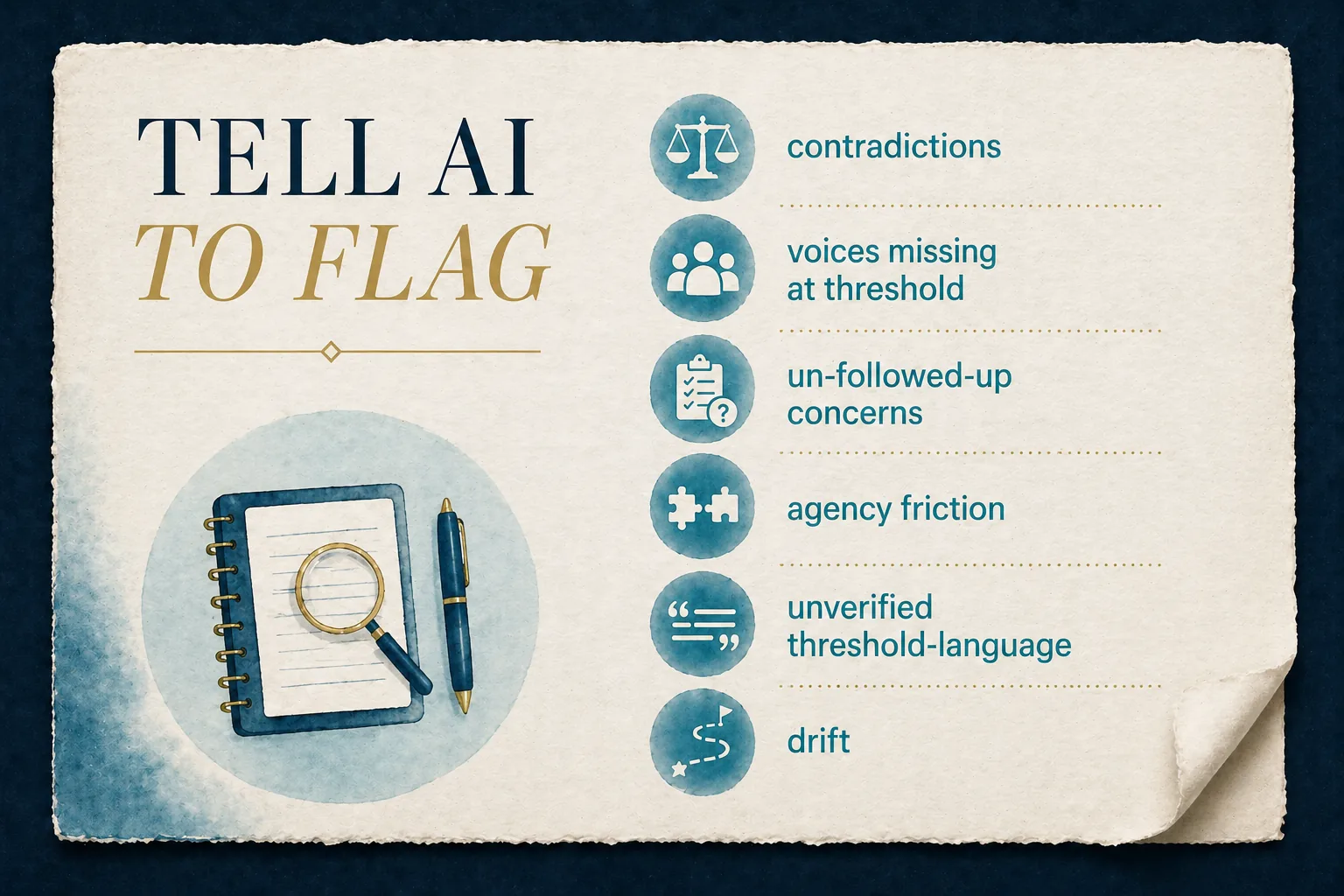
The safeguarding friction list
Whatever the use case, name these in your prompt explicitly, or AI will not surface them.
Contradictions across notes. Same parent, two different accounts of capacity to protect, six months apart.
Voices missing at threshold moments. The child's words present early in the case, absent by the time risk escalated. The Serious Case Review pattern.
Concerns raised once and not actioned. A single line about a stepfather's behaviour, never returned to.
Friction between agencies. Police, health, school seeing the same family differently.
Threshold-language that crept in without verification. "Significant harm", "chaotic", "unable to protect". Words doing legal work that nobody evidenced.
Drift across time. The trajectory of the case toward or away from the s47 / s42 threshold, and where the framing changed.
Three safeguarding use cases, one principle
Safeguarding case notes: context before a visit or a referral
You are writing a case note after a visit, or drafting a referral. You want AI to brief you on what is already in the file that bears on the safeguarding question.
"Read the last twelve months of records. Flag every safeguarding concern that was raised and not followed up. Flag any contradictions in how the parent's mental health was described. Flag what the child has said directly versus what the parent has said about the child. Cite date and author for everything."
Safeguarding supervision: preparing a case for discussion
You are bringing a case to safeguarding supervision because something does not sit right.
"Help me articulate what is bothering me about this case. List the friction points: where the agencies disagree, where the chronology jumps, where my own notes contradict each other, where I have described risk more cautiously in writing than I felt in the room. Cite source for every item."
Safeguarding reports: drafting for a multi-agency audience
You are drafting a strategy meeting briefing, an ICPC report, a s47 enquiry summary, or a court report.
"Draft sections by agency contribution. Keep each agency's language and source-tag every claim. Where two agencies framed the same observation differently, surface both. Where a concern was raised but not resolved, flag it. Where a threshold word appears, attribute it to the agency or note that introduced it. Do not synthesise into a single voice."
Different use case, same instruction at the top: surface the friction.
The verbatim test
A 30-second check before any AI extraction goes into a safeguarding document:
The test
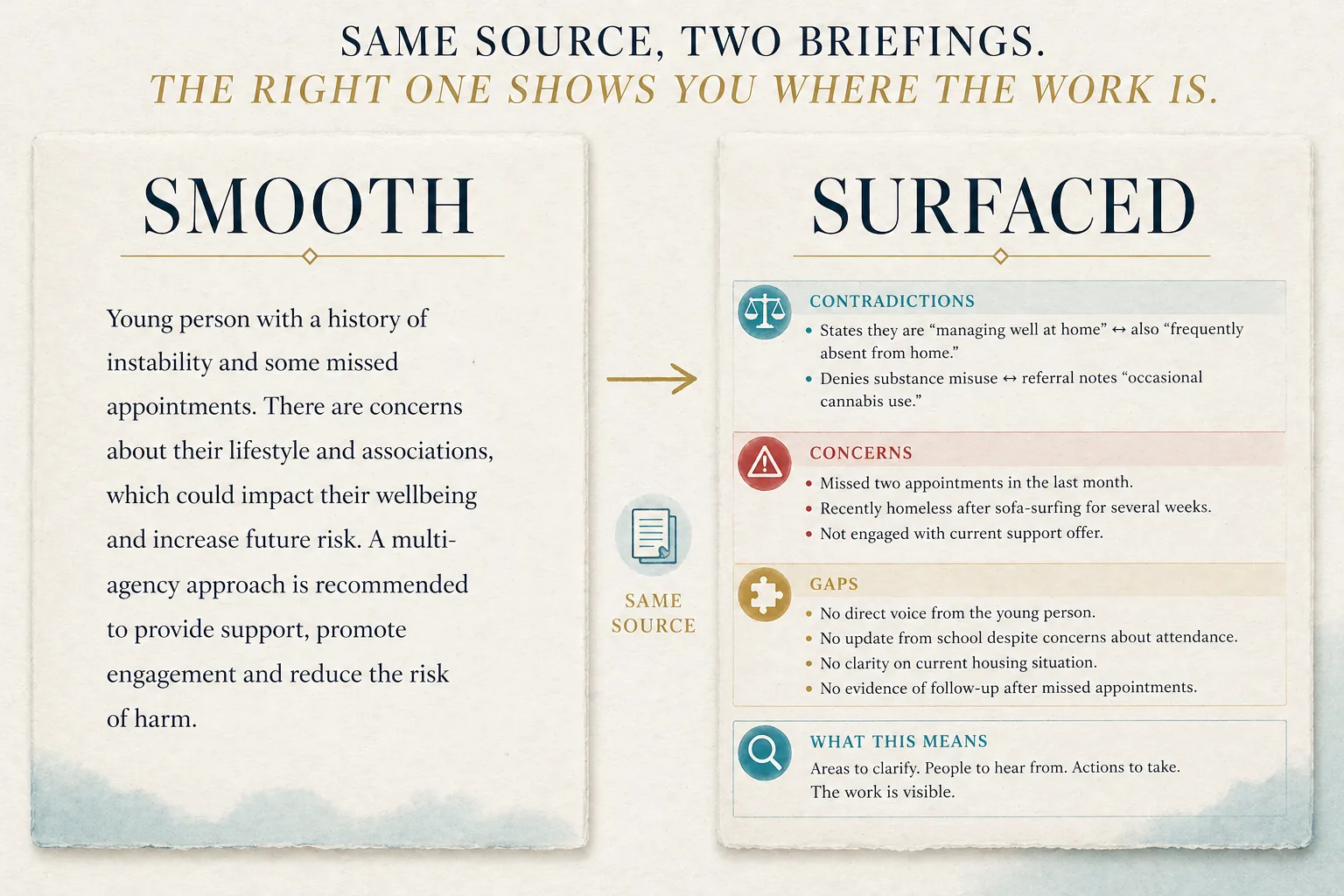
"If I removed every smooth bit from this output, what would be left? Does what remains contain the contradictions, the gaps, the un-followed-up concerns? If the answer is 'almost nothing', AI smoothed it. Re-prompt with the friction list."
Same source, two briefings. The right one tells you where the safeguarding work is.
Apply this test to the AI draft, not just the final document. The earlier you catch the smoothing, the easier it is to ask AI for the unsmoothed version. The further down the chain it goes (supervisor, DSL, strategy meeting, court), the harder it is to spot what is missing.
In safeguarding, smooth is dangerous. The signal lives in the contradictions, the gaps, and the things people said but nobody followed up.
Reflection
Pick a safeguarding case from the past quarter where AI summarised any part of the record. Read the output again with one question in mind: what was in the file that AI smoothed out, that mattered? Add that to your next prompt's friction list.